

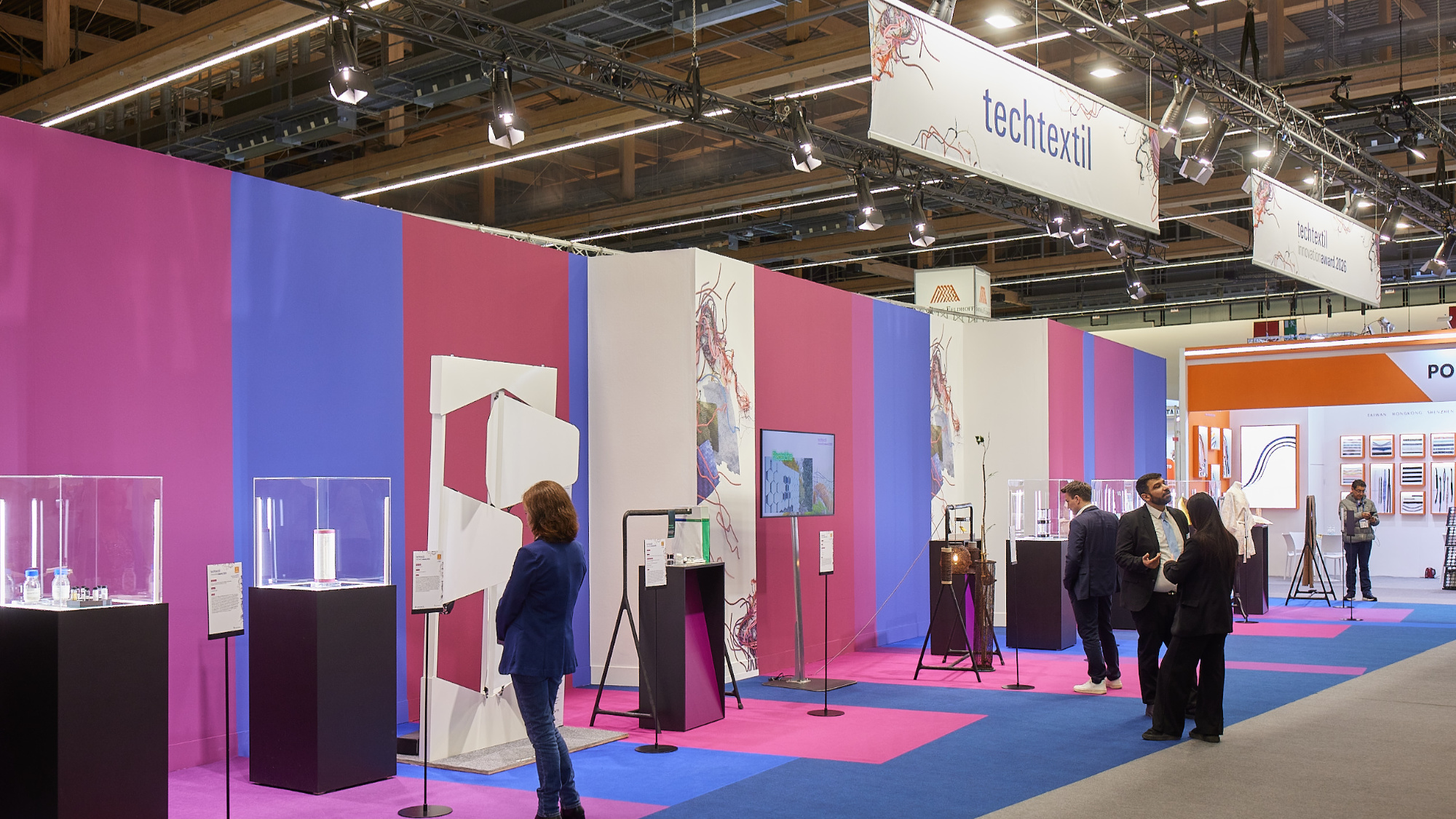

The Techtextil Innovation Award honours outstanding ideas in textile technology, sustainability, AI and the creation of technical textiles. Experience new, progressive ideas – selected by an international jury of experts. In Hall 11.1, C51, Techtextil showcased the best in nonwovens, functional clothing and technical textiles.
The best innovations for your application
Our renowned jury of experts selects the best innovations in seven categories – from new materials to new production technologies. These progressive ideas are driving forces for numerous industries, such as automotive, medical and construction.
Take advantage of our jury's expertise. Discover the best innovations in the textile industry live at Techtextil – and find new solutions and partners for your application.
Winners Techtextil Innovation Award 2026
Northern Lights instead of chemicals: finishing textiles without PFAS
Per- and polyfluoroalkyl substances (PFAS) give technical and outdoor textiles water-, oil- and stain-repellent properties. However, these so-called ‘forever chemicals’ are facing regulatory pressure worldwide due to their environmental and health risks – ranging from EU-wide restrictions to national bans. “EC0Tex” demonstrates that the textile industry is working intensively on PFAS-free finishing alternatives. With the new process, both inelastic and highly elastic yarns can be finished to be permanently water-repellent and quick-drying without the use of PFAS or fresh water. For this, the Swiss yarn manufacturer Bäumlin & Ernst receives a Techtextil Innovation Award 2026 in the “New Concept” category. The patented EC0Tex process is based on a plasma system developed by the project partner Empa (Swiss Federal Laboratories for Materials Science and Technology). It uses dry plasma – a reactive gas that physically resembles the aurora – to coat every single filament of a yarn with an ultra-thin organosilicon layer. This makes the yarns water-repellent and quick-drying – and, at the end of their life cycle, they break down into silicon dioxide, i.e. sand. “EC0Tex demonstrates that a nanometre-thin plasma coating is sufficient to achieve performance properties that were previously the preserve of PFAS,” says Bernd Schäfer, CEO of Bäumlin & Ernst. Over the next twelve months, the EC0Tex project partners Lothos and Seilfabrik Ullmann plan to launch the first PFAS-free swimming and water sports products. Schäfer says: “For us, the Techtextil Innovation Award is a milestone.”
Textile nanotubes for electric cars, humanoid robots and aircraft
Carbon nanotubes (CNTs) are microscopically small cylinders made of carbon atoms with remarkable properties: they are up to 100 times stronger than steel, electrically conductive and feather-light. Their potential is already being harnessed in lithium-ion batteries, electronics and sports equipment. The South Korean nanotechnology company aweXome Ray now aims to make CNTs usable in the textile industry. To this end, the company has developed a special direct spinning process. For the first time, it transforms CNTs – previously available mainly as powders or pastes – into scalable, textile-compatible continuous filaments and non-woven membranes. These can be processed with textile techniques such as twisting, braiding and laminating. For the innovation “axrial”, aweXome Ray is awarded a Techtextil Innovation Award 2026 in the “New Concept” category. “With axrial, we are bridging the gap between nanotechnology and the textile industry and transforming passive textiles into active electronic and thermal functional components,” says Managing Director Se Hoon Gihm. He founded aweXome Ray with two colleagues from a research laboratory at Seoul National University. Potential applications range from on-board electrical systems in electric cars, aircraft and humanoid robots, to EMI shielding, seat heating systems and smart textiles. Initial research collaborations with a major car manufacturer and an aerospace company are already underway. aweXome Ray plans a first mass-production facility up and running by 2028. Techtextil 2026 marks axrial’s official international debut.
Textile printing pastes from waste, not petroleum
CITEVE demonstrates how local waste from the industrial, food and agricultural sectors can be transformed into high-quality, sustainable textile printing pastes for fashion and home textiles. The Portuguese technological centre has developed bio-based (over 94 per cent) and water-based printing pastes as an alternative to petroleum-based formulations. For this work, CITEVE receives a Techtextil Innovation Award 2026 in the “New Chemicals & Dyes” category. The patent-pending pastes are designed to reduce reliance on fossil-based raw materials in textile printing. Instead of conventional petrochemicals, the formulations use binders and thickeners made from biopolymers such as collagen and chitosan, derived from food-industry by-products. The colour pigments are produced through fine mechanical grinding (micronisation) of waste materials such as vine prunings, pine bark and ash from biomass boilers. The resulting particles are smaller than 45 micrometres and are compatible with rotary screen printing, one of the world’s most widely used textile printing methods. “Our pastes are revolutionary because they enable sustainable textile printing by combining environmentally friendly formulations with industrial applicability,” says Augusta Silva, Innovation Manager for Textile Printing and Coating at CITEVE. “The Techtextil Innovation Award validates the excellence of our research.” CITEVE developed this in collaboration with the research centre CeNTI and the company Lameirinho Indústria Têxtil. The print quality achieved with these new textile printing pastes can be experienced at Techtextil, where CITEVE presents the bio-based pastes to an international professional audience for the first time, including examples of printed textile products.
Goodbye PFAS: Textile water repellency at molecular level thanks to agricultural waste
The search for alternatives to PFAS, the so-called ‘forever chemicals’, is one of the most pressing challenges facing the textile industry. In France, the government has already taken action: from January 2026, the sale of apparel containing PFAS will be gradually banned, with other textiles set to follow. An innovative answer to upcoming global bans is provided by the French deep-tech start-up H&B Materials, founded in 2025. For this, it receives a Techtextil Innovation Award 2026 in the “New Chemicals & Dyes” category: a PFAS-free water-repellent textile finish based on fatty acids derived from agricultural waste. The founders Hichem Ichou and Baptiste Andrin had the idea at the CEISAM Research Institute for Molecular Chemistry at Nantes University. “We asked ourselves: what if we could make textiles water-repellent at a molecular level, rather than using traditional coating methods?” explains Ichou. So they developed a patented grafting process: it anchors water-repellent groups of plant-based fatty acids directly to cellulose fibres at the molecular level using ‘mild’ chemistry – the water-repellent protection (lotus effect) thus becomes an integral part of the fibre structure. In spray tests – the industry benchmark for water repellency – this innovation reaches scores of 5 out of 5 on cotton and blended fabrics. Of interest to finishers and manufacturers of technical textiles: the process is compatible with finishing systems such as Foulard and Stenter (plug-and-play). Strengthened by the Techtextil Innovation Award, H&B Materials is planning a seed capital funding round for 2026 to establish an initial industrial pilot line.
When wood becomes knittable
Every year, 50 to 70 million tonnes of lignin are generated worldwide. The biopolymer, which acts as ‘nature’s glue’ to give plants and trees strength, is produced as a by-product of the paper and pulp industry – and to date, 98 to 99 per cent of it is burned. The German design studio spek Design demonstrates how this potential can be harnessed for sustainable textile materials: “FormLig – Knitted Wood” was developed in collaboration with the German Institutes of Textile and Fibre Research Denkendorf (DITF) and the companies Tecnaro and Buck. The new composite material combines yarns made from renewable raw materials such as cellulose with a lignin coating. It can be processed on knitting machines into flat or tubular knitted fabrics, which are then heated, shaped into individual forms and permanently set. The research group wins a Techtextil Innovation Award 2026 in the “New Material” category for its compostable and microplastic-free “knittable wood”. “FormLig is a material that is unique worldwide, and its potential applications are only just beginning,” says Patrick Sauter, Managing Director at spek Design, which also realises design projects for Mercedes-Benz. Potential applications range from packaging and furniture to forestry and horticulture, for example as a compostable tree guard. “For all project partners, the Techtextil Innovation Award is far more than just a symbolic achievement – it has strategic significance and can be a decisive door-opener, particularly when it comes to sustainable materials,” says Sauter.
Biopolyester combines high performance with biodegradability
In its search for sustainable alternatives to conventional polyester (PET), the textile industry faces a key challenge: how can biodegradability be combined with the performance standards of synthetic fibres and industrial scalability, whilst avoiding microplastics? This is precisely where the Dutch research and development company Senbis Polymer Innovations comes in: Senbis receives a Techtextil Innovation Award 2026 in the “New Material” category for a novel performance biopolyester that combines biodegradability with the properties of synthetic fibres. The award recognises the new product “Mariva”. According to Senbis, this bio-based high-performance polymer for the production of fibres and textiles has properties similar to those of PET and polyamide (PA). At the same time, it is chemically recyclable and biodegradable without producing microplastics. Mariva has been developed to be processed on conventional polyester polymerisation and melt spinning lines (drop-in solution). This enables industrial-scale production. Pilot trials show that Mariva can be spun on standard PET machinery. In April 2026, the Senbis team founded the start-up Mariva Materials and secured investors to develop the first commercial applications in sportswear, functional apparel, footwear, technical textiles and non-wovens. “We are breaking new ground,” says Kasper Nossent, CCO and co-founder of Mariva Materials. “With Mariva, we are creating a new polymer category for textiles for the first time, positioned between PA, PET and polylactic acid (PLA).” Mariva celebrates its exclusive world premiere at Techtextil 2026.
Bio-based car interiors: wood that behaves like fabric
Wood is rigid – or at least it used to be. The German company NUO manufactures wood-textile composites that combine the aesthetic appeal of wood with the flexibility of textiles. The “wood textiles” are already being used in the interiors of car brands such as Fiat and Renault. Until now, wood veneers – thin decorative sheets of wood – and textiles have been bonded using fossil-based adhesives. In collaboration with the German Institutes of Textile and Fibre Research Denkendorf (DITF), NUO has for the first time developed fully bio-based wood textiles that also meet the stricter sustainability requirements in the automotive industry. NUO receives a Techtextil Innovation Award 2026 in the “New Product” category for its new material, “NUO FlexHolz”. Veneers from sustainable forestry, such as walnut or oak, are bonded with a natural fibre fabric made from hemp. Instead of petroleum-based adhesives, a lignin-based film is used – a by-product of the paper and pulp industry that has so far mostly been burned. The flexibility is achieved through a special lasering process that engraves fine patterns into the wood surface (laser microsegmentation) without damaging the fabric underneath. “The combination of textile research and practical woodworking shows that sustainable materials have long since become more than a niche product,” says Rolf Loose-Leonhardt, Managing Director of NUO and its parent company Schorn & Groh, whose wood veneers feature in Apple Stores and the Elbphilharmonie in Hamburg. NUO FlexHolz is market-ready and, in addition to door panels and consoles in car interiors, could also be used in furniture and interior design. Visitors can experience what it feels like in the special area of the Techtextil Innovation Award in Hall 11.1.
AI-controlled facade: fibre-reinforced facade as a climate protection agent
The building sector is a sleeping giant when it comes to climate protection: According to the United Nations Environment Programme (UNEP), around 34 per cent of global CO2 emissions are attributable to the construction and operation of buildings. The Institute for Textile and Fiber Technologies (ITFT) at the University of Stuttgart demonstrates how this potential can be harnessed with “FlectoLine” – a flexible facade made of fibre-reinforced composite modules. These can be positioned in real time depending on the position of the sun, daylight and temperature, actively improving the energy efficiency of buildings. For this, the ITFT receives a Techtextil Innovation Award 2026 in the “New Product” category. Measurements carried out by the ITFT show: The ‘intelligent’ facade reduces the indoor temperature by up to 8 °C in summer and increases the time in the thermal comfort zone from 25 to 75 per cent – without requiring any additional heating or cooling energy. The system is controlled by AI: it calculates the optimal angle of the 1.5-metre-high FlectoLine modules based on weather data. Integrated photovoltaic cells also generate electricity. “Textiles are playing an increasingly important role in shading and the flexible adaptation of buildings to climatic conditions,” says Matthias Ridder, a research associate at the ITFT. The project also involves the Institute of Building Structures and Structural Design (itke) at the University of Stuttgart, as well as the companies HELLA Sonnen- und Wetterschutztechnik, Jehle Technik and Formfinder Software. An over two-metre-high model of the FlectoLine facade is on display in the Techtextil Innovation Award special area.
Toxic-free gel spinning: UHMWPE fibres without hexane
Ultra-high-molecular-weight polyethylene (UHMWPE) is regarded as one of the most high-performance fibre materials for technical textiles due to its extreme strength: up to 15 times stronger than steel, it is used to manufacture surgical sutures, body armour, high-strength offshore ropes and cut-resistant gloves. However, production has so far had an environmental drawback: in the traditional gel spinning process, UHMWPE is mixed with oil to form a gel-like mass and processed into fine strands. The oil is then washed out again with toxic solvents such as hexane or dichloromethane. The consumption is enormous: around 100 kilograms of these solvents are required per kilogram of yarn. The British textile machinery manufacturer Fibre Extrusion Technology (FET) has now developed a sustainable gel spinning process for UHMWPE yarns that works without hexane or dichloromethane. Instead, it uses supercritical carbon dioxide (scCO2) – a non-toxic medium that is often a by-product of industrial processes and is already used in the textile industry for waterless dyeing. For this, FET receives the Techtextil Innovation Award 2026 in the category “New Production Technology, Digitalisation & AI Solutions”. According to FET, this marks the beginning of a “new era” in the clean, small-scale production of ultra-high-performance polymer fibres for medical devices, protective equipment and composites. “We are proud that the Techtextil Innovation Award recognises our intensive work. It shows that we are at the forefront of technological developments supporting the textiles of tomorrow,” says FET’s Managing Director, Richard Slack. The “FET-500” plant is in its first commercial phase since the end of 2025. Techtextil 2026 is the first textile trade fair worldwide at which FET presents the new system.
Endless textile recycling with AI and ‘plastic-eating’ enzymes
The world is producing more textile fibres than ever before: in 2024, fibre production reached a record high of around 132 million tonnes. Around 70 per cent are synthetic fibres, primarily polyester and nylon, which are rarely recycled at present. The Australian biotech company Samsara Eco aims to shift the industry away from the linear ‘take-make-waste’ model: it receives a Techtextil Innovation Award 2026 in the ‘New Recycled Materials & Recycling Technologies’ category for its enzyme-based recycling technology ‘EosEco’. The method uses AI-engineered ‘plastic-eating’ enzymes. These break down polyester, nylon 6 and the particularly resistant nylon 6,6 in such a way that new-quality fibres are produced. ‘Whether recycled once or a hundred times – our recycled materials are identical every time,’ says Paul Riley, founder and CEO of Samsara Eco. The backbone of the technology is AI: it ‘designs’ new enzymes, learns from obsolete variants and feeds into a growing enzyme library. In 2024, Lululemon launched its first products made from enzymatically recycled polyester and nylon 6,6. A ten-year contract with Samsara Eco covers around 20 per cent of the brand’s fibre portfolio. Other partners are Nilit and The Lycra Company – the latter with the aim of bringing elastane, the “recycling killer”, into the circular economy. “The Techtextil Innovation Award proves the potential of our technology to create an infinite circular economy for synthetic fibres and helps the textile industry finally move away from the linear ‘take-make-waste’ model,” says Riley.
Start-up cracks chemical recycling code
Less than one per cent of all textile waste worldwide is recycled in textile-to-textile loops. Mixed textiles in particular are often incinerated or disposed of in landfill. Chemical textile recycling holds promise for closed-loop systems – but faces an environmental hurdle: Hydrolysis, one of the most efficient processes for mixed textiles, generates around one tonne of chemical waste salt per tonne of polyester recovered. The reason: recovering the fibre components requires acid, which remains as salt sludge. The German start-up re.solution now replaces this acid step with electricity. This prevents salt waste during the production of circular polyester from mixed textile waste. For this world-first electrochemically assisted hydrolysis, re.solution is awarded a Techtextil Innovation Award 2026 in the “New Recycled Materials & Recycling Technologies” category. According to re.solution, the new process saves 94 per cent of chemicals and 74 per cent of water compared with similar chemical recycling processes. This reduces the carbon footprint by up to 90 per cent compared with the production of virgin polyester. “The Techtextil Innovation Award gives our young team credibility, visibility and a boost in an industry that is currently undergoing fundamental change,” says Amrei Becker, Managing Director and co-founder of re.solution. The start-up is a spin-off from the Institut für Textiltechnik (ITA) and the Aachener Verfahrenstechnik (AVT) of RWTH Aachen University. A semi-industrial plant with a capacity of over one tonne of textile waste per day is set to go into operation in mid-2026 and, according to Becker, is already attracting significant interest from textile collectors, sorters, fashion companies and manufacturers of technical textiles.
Our expert jury
The calibre of judges on the panel shows how important the Techtextil Innovation Award is:
Eng. António Braz Costa, General Manager
Technological Centre for the Textile and Clothing Industry of Portugal (CITEVE), Portugal
Johannes Diebel, General Manager
Research Council of Textiles (FKT) e.V., Germany
Isabelle Ferreira, Deputy Scientific Director – Innovation
The French Institute of Textiles and Clothing, France
Dr. Heike Illing-Günther, Managing Director
Saxon Textile Research Institute e.V., Germany
Dr. Jan Laperre, General Manager
Centexbel, Belgium
Prof. Dr. René Rossi, Head of Laboratory for Biomimetic Membranes and Textiles
Swiss Federal Laboratories for Materials Science and Technology (EMPA), Switzerland
Dr.-Ing. Thomas Stegmaier, Chief Sustainable Officer, Competence Center Textile Chemistry, Environment & Energy
German Institutes of Textile and Fiber Research (DITF), Germany
Prof. Dr. Henry Yi Li, Chair of Textile Science and Engineering & Chairman, Textile Bioengineering and Informatics Society
The University of Manchester, Department of Materials, School of Natural Sciences, Great Britain
The Categories
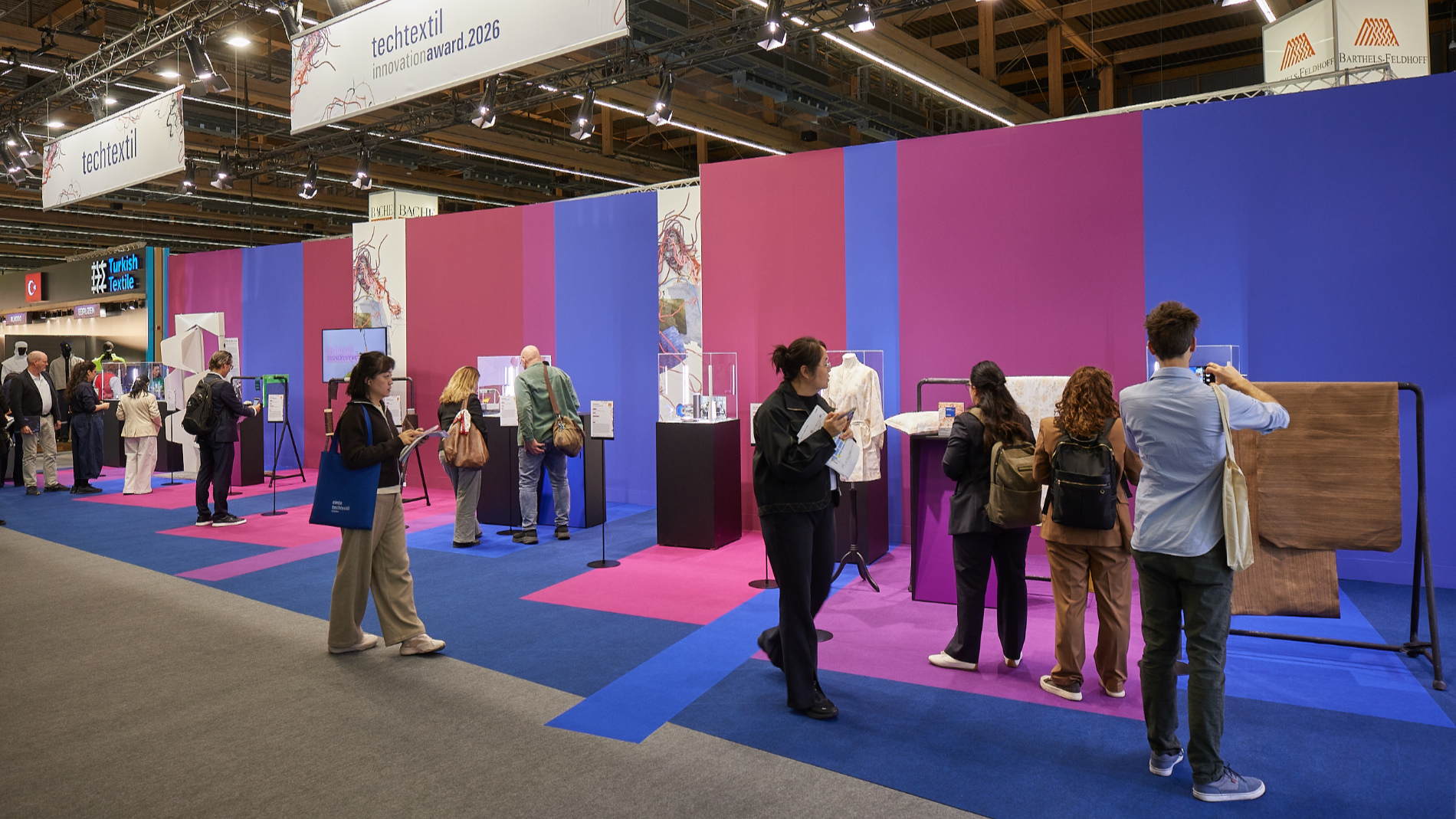
- New Concept
- New Material
- New Application
- New Product
- New Chemicals & Dyes
- New Recycled Materials & Recycling Technologies
- New Production Technology, Digitalisation & AI Solutions